Amplitude explains product behavior. Beseam connects it to the rest of the shopping journey.
Amplitude is designed for product analytics: funnels, retention, cohorts, journeys, replay, experimentation, and product growth. Beseam combines product analytics with store, campaign, reliability, order, and revenue data so you can decide what to change and check the result.
Product analytics · reviewed August 22, 2026
Choose Amplitude when
Choose Amplitude when product teams need self-serve behavioral analytics, cohorts, retention, experimentation, and product development processes.
Choose Beseam when
Choose Beseam when the unit of work is a commerce product, page, query, campaign, or store issue, and the decision must include revenue consequence and who owns the change.
Use both when
Amplitude can remain the product analytics and experimentation environment. Beseam can surface the commerce issue that deserves analysis or an experiment and verify the result across the wider stack.
What it does not replace
What Beseam does not replace
Beseam does not replace Amplitude's general product analytics, retention and cohort analysis, feature analytics, or broad product experimentation processes.
In practice
What changes in practice.
Checked August 22, 2026
Typical owner
Product, growth, analytics, and data teams measuring digital-product adoption and behavior.
Ecommerce or commerce operations, with product, growth, marketing, or engineering involved as the question requires.
Setup
Instrument events and identity, define the tracking plan, then manage cohorts, governance, and product analytics views.
Connect the relevant store and data sources around the business question being investigated.
Primary output
Product analytics, funnels, cohorts, retention, session replay, experimentation, and AI-assisted analysis.
An evidence-backed decision, owned action, explicit brand-owner approval, and check again of the original problem.
Replace or keep?
Keep Amplitude when product analytics and experimentation are core operating systems for the team.
Use Beseam when those signals need to be reconciled with storefront, discovery, campaign, reliability, order, and revenue evidence.
Pricing model
Free and self-serve Plus options, with Growth and Enterprise using custom event-based pricing.
No public self-serve price on beseam.com; scope starts with a commerce review.
Choose the tool that fits the job.
Choose Amplitude when
- Product adoption, retention, cohorts, and feature behavior are the central questions.
- Product managers need self-serve event analysis and experimentation.
- The organization is building digital products beyond commerce storefront operations.
Choose Beseam when
- The issue crosses product data, storefront content, AI discovery, advertising, behavior, incidents, and orders.
- The team needs a commerce-specific priority and owner, not only an analytical finding.
- The result must reconcile commerce money and become evidence for the next decision.
Compare how each tool works.
Primary job
Understand product behavior, engagement, retention, journeys, and feature impact.
Connect store and sales data to a specific decision, approved change, and measured result.
Core object
Users, accounts, events, cohorts, funnels, and features.
Stores, products, pages, queries, customer journeys, campaigns, incidents, and revenue periods.
Experimentation
Integrated product and feature experimentation with behavioral cohorts and metrics.
An experiment or optimization change is one possible change after the team understands the commerce problem and decides it deserves action.
Decision output
Charts, cohorts, dashboards, replay, and experiment results.
What the shopper did, the affected product or page, the owner, approval, change, and measured result.
Best relationship
Product analytics and experimentation system.
Keeps the business question and its evidence attached when deeper product analysis or experimentation is the right next step.
What happens after the signal appears?
Ask a product question
Teams explore funnels, retention, journeys, cohorts, and replay.
Beseam connects the relevant store and sales data and surfaces the strongest supported problem or opportunity and proposes the next supported move.
Build a hypothesis
Product teams interpret behavior and define a test or product change.
The issue already includes the affected product, page, query, or journey, evidence, consequence, and proposed next move.
Run the change
Amplitude Experiment or another delivery system runs the test or rollout.
Beseam keeps owner and approval explicit and can use the existing platform for execution.
Learn
Experiment and analytics results inform the product roadmap.
The measured result becomes evidence for the next decision.
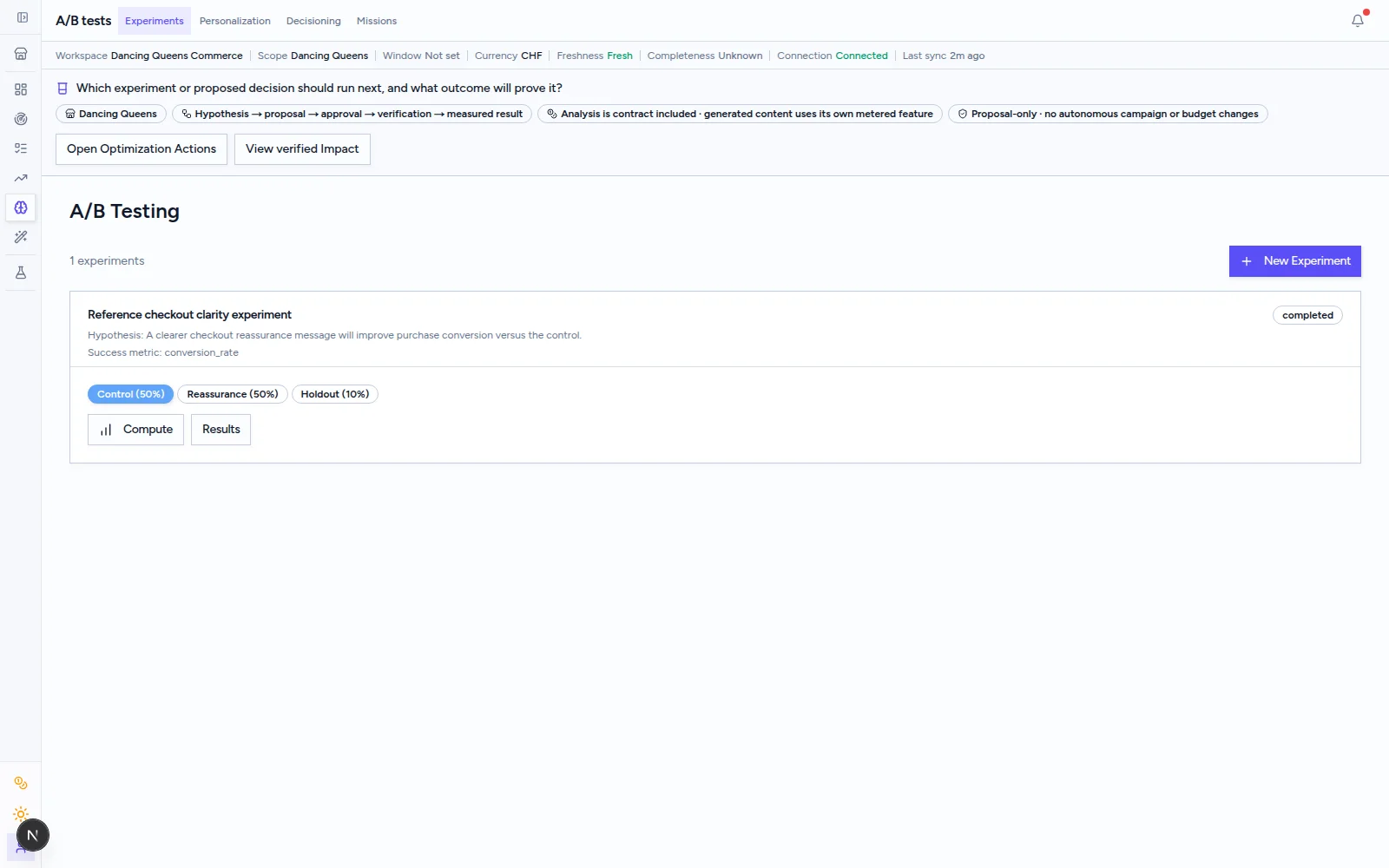
Real Beseam optimization workspace. An experiment is one governed change inside a wider evidence-to-action trace.
FAQ
Before you change the stack.
Does Beseam replace Amplitude?
No for teams that need broad product analytics, cohorts, retention, and feature experimentation. Beseam focuses on commerce-specific cross-system decisions and actions.
Can Beseam and Amplitude work together?
Yes. Beseam can connect the store and sales data and use the connected data to determine whether deeper behavioral analysis or experimentation is the right next step; Amplitude can support that work where appropriate.
How is Beseam's data model different?
Amplitude centers users, events, cohorts, funnels, and features. Beseam centers stores, products, pages, queries, campaigns, incidents, actions, and revenue periods.
Sources reviewed
Official product sources · August 22, 2026
Related comparisons
Keep the systems that work. Connect the evidence they leave apart.
In a 20-minute store review, we use one real finding to show how Beseam connects the tools already in place and keeps the loop moving from evidence to measured change.