Triple Whale measures ecommerce performance. Beseam uses that data to decide what to change next.
Triple Whale brings ecommerce analytics, attribution, marketing performance, website conversion, retention, and portfolio reporting together. Beseam uses measurement as evidence alongside catalog, storefront, AI discovery, behavior, reliability, campaigns, actions, orders, and revenue to keep surfacing what deserves action and learning from what changed afterward.
Commerce analytics · reviewed August 22, 2026
Choose Triple Whale when
Choose Triple Whale when unified ecommerce reporting, attribution, marketing performance, retention, and portfolio analytics are the central buying need.
Choose Beseam when
Choose Beseam when the hard part is connecting measurement to the affected product, page, campaign, or journey, deciding what deserves action, making a specific change, and measuring what changed afterward.
Use both when
Use Triple Whale for commerce measurement and attribution and Beseam to connect that evidence to what the shopper chooses, approved change, and learning afterward. Where the contracted setup connects the data, the evidence can remain attached to the relevant product, page, campaign, or revenue period.
What it does not replace
What Beseam does not replace
Beseam does not replace Triple Whale's full attribution, marketing mix, ecommerce dashboard, retention, or portfolio reporting processes.
In practice
What changes in practice.
Checked August 22, 2026
Typical owner
DTC founders, growth and performance teams, ecommerce operators, and agencies managing channel performance.
Ecommerce or commerce operations, with product, growth, marketing, or engineering involved as the question requires.
Setup
Connect ecommerce and marketing channels, install Triple Pixel where required, and configure attribution and reporting views.
Connect the relevant store and data sources around the business question being investigated.
Primary output
Attribution, business reporting, first-party measurement, BI, AI analysis, and increasingly governed automated actions.
An evidence-backed decision, owned action, explicit brand-owner approval, and check again of the original problem.
Replace or keep?
Keep Triple Whale when DTC attribution and channel-performance operations are central to the stack.
Use Beseam when the business question crosses attribution, discovery, store behavior, product data, reliability, and who owns the change.
Pricing model
Free and paid packages; current paid pricing scales by package and annual GMV, with enterprise terms for larger brands.
No public self-serve price on beseam.com; scope starts with a commerce review.
Choose the tool that fits the job.
Choose Triple Whale when
- Paid media attribution and ecommerce reporting are the main priorities.
- The team needs unified dashboards for acquisition, conversion, retention, or multiple stores.
- Marketing performance analysis is the primary process.
Choose Beseam when
- The issue extends beyond attribution into product, catalog, AI discovery, experience, campaign readiness, or reliability.
- The team needs one change backed by the data with owner and business context.
- Measurement must be connected to the actual product, page, query, or journey and verified change.
Compare how each tool works.
Primary job
Unify ecommerce analytics, marketing attribution, conversion, retention, and portfolio reporting.
Connect store and sales data to a specific decision, approved change, and measured result.
Measurement depth
Strong marketing and ecommerce measurement, including attribution and business reporting.
Keeps booked, observed, attributed, and modeled values distinct while using each as evidence.
What it applies to
Dashboards and analysis across orders, marketing, customers, products, and stores.
The exact product, page, query, campaign, journey, or incident attached to the issue and action.
Action model
Teams use reporting to make decisions in their operating tools.
The decision, owner, approval, change status, and result stay together.
Best relationship
Commerce analytics and attribution source.
Revenue decision and action layer that can incorporate the measurement.
What happens after the signal appears?
Measure performance
Dashboards show acquisition, attribution, conversion, retention, and business performance.
Measurement is combined with catalog, storefront, AI discovery, behavior, campaign, and reliability data.
Find the cause
Teams investigate the relevant reports and channels.
The issue is attached to the affected product, page, query, or journey and considered alongside the other business data.
Act
The team moves into advertising, commerce, content, or product systems.
The action retains its evidence, owner, approval requirements, and business context.
Reconcile the result
Marketing and commerce reports show subsequent performance.
Beseam verifies the original problem while preserving the meaning and source of each money metric.
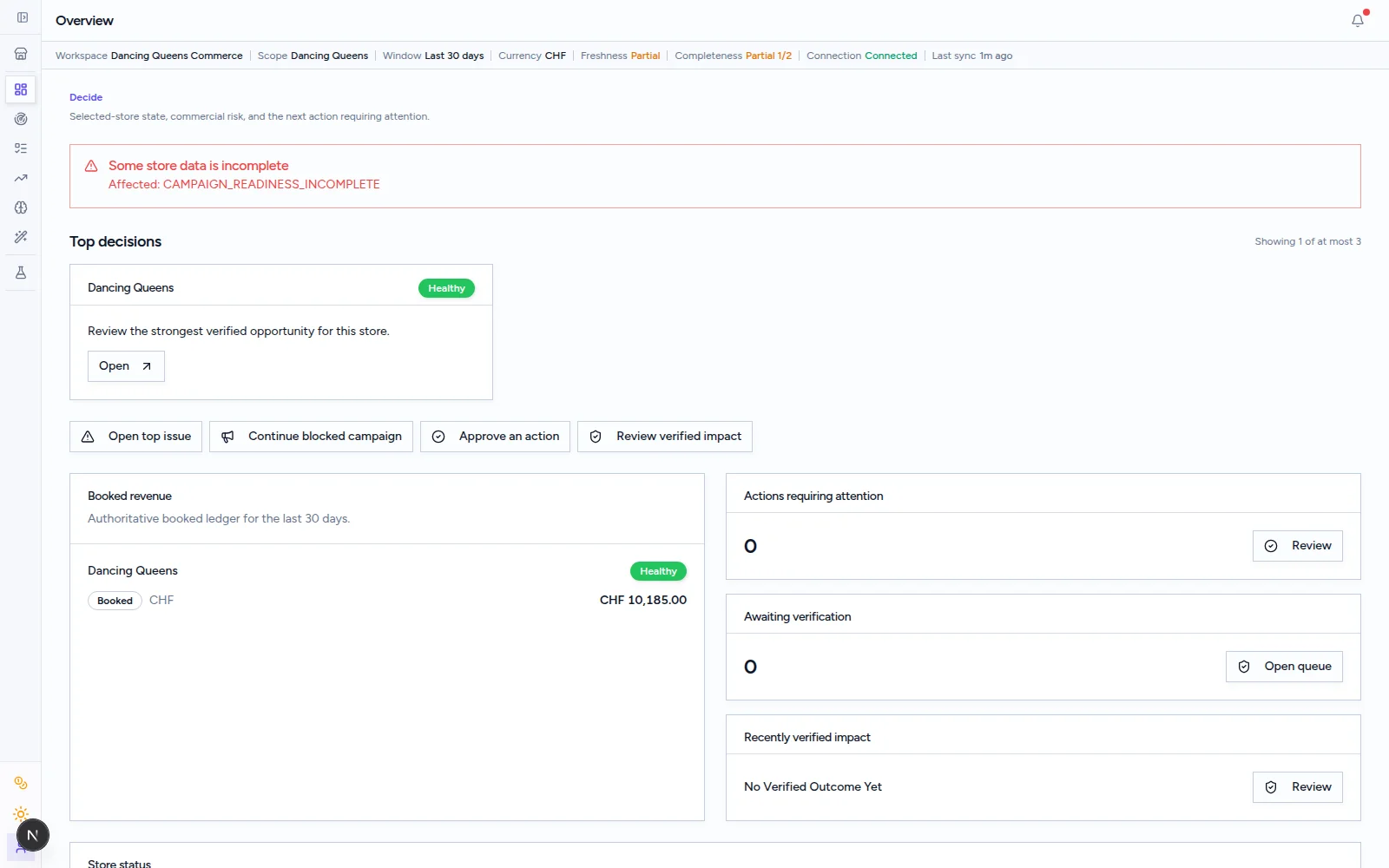
Real Beseam revenue overview. Measurement is the beginning of the decision trace, not the end of the process.
FAQ
Before you change the stack.
Does Beseam replace Triple Whale?
Not when the main requirement is deep ecommerce attribution, marketing reporting, retention analytics, or portfolio reporting. Beseam connects that measurement with the other product, store, and shopper data, the decision, approved change, and learning afterward.
Can Beseam use attribution data?
Beseam's metric model can preserve attributed values as attributed evidence rather than presenting them as booked revenue. The exact connected sources depend on the store's setup.
What does Beseam add after the dashboard?
Beseam connects the evidence to a specific product, page, query, campaign, journey, or incident, assigns the next action, and verifies the original problem after the change.
Sources reviewed
Official product sources · August 22, 2026
Related comparisons
Keep the systems that work. Connect the evidence they leave apart.
In a 20-minute store review, we use one real finding to show how Beseam connects the tools already in place and keeps the loop moving from evidence to measured change.