How to get your products recommended by ChatGPT and other AI assistants
By The Beseam team · Updated · 8 min read
Why do AI recommendations matter for webshops?
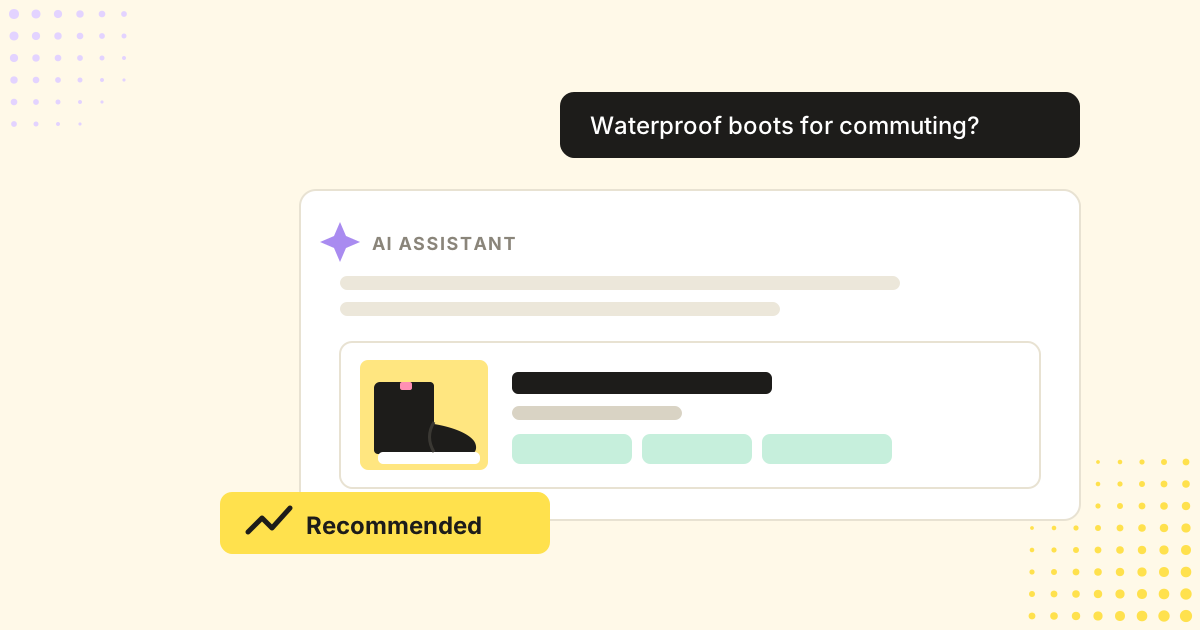
More shoppers now ask an AI assistant what to buy instead of scrolling through search results. The assistant answers with a short list of products, and the shopper often clicks straight through to one of them. If your products are not in that list, you are not part of the decision.
The traffic is still small next to search and ads, but it grows fast and it converts. According to Adobe's data on US retail sites, AI-referred visits were up 62% year over year in July 2026, converted 60% better than other traffic and brought 53% more revenue per visit. In March 2025, the same traffic still converted 38% worse.
What this means
AI is becoming a sales channel of its own. The stores that get recommended now build a lead that is hard to catch up on later.
How does ChatGPT decide which products to recommend?
OpenAI says its product results are selected independently and are not ads, so you cannot pay to be included. Its help centre lists the factors it uses to rank merchants for a product: availability, price, quality, and whether a merchant is the maker or primary seller of the item. OpenAI also says these factors will keep evolving.
Underneath, assistants combine two kinds of information: structured product data from merchant feeds and catalogues, and what they read on the open web, including your product pages, reviews and articles. Other assistants work along the same lines: they need to find your product, understand what it is and who it is for, and trust that the facts are right.
| What the assistant needs | Where it gets it | What you control |
|---|---|---|
| To find your product | Product feeds, catalogue integrations, crawlers | Feed setup, crawler access, sitemap |
| To understand it | Product pages, product data, structured data | Descriptions, attributes, schema |
| To trust it | Matching prices and stock, reviews, other sources | Data accuracy, reviews, content |
Step 1: Make sure AI assistants can reach your products
Assistants can only recommend what they can read. Start with two checks.
- Product feeds and catalogues. OpenAI says Shopify product data is already integrated into ChatGPT through Shopify Catalog, with no extra work for individual merchants. Merchants on other platforms can apply to send a product feed directly. In your Shopify admin, check Sales channels to see which AI channels are active for your store, since availability differs by channel and country.
- Crawler access. AI companies use their own crawlers, such as OpenAI's OAI-SearchBot. Bot protection, firewall rules or an old robots.txt rule can block them without anyone noticing. Check that the crawlers of the assistants you care about are allowed to reach your product and collection pages.
Step 2: Give every product page the facts shoppers ask about
Shoppers ask assistants specific questions: “waterproof boots for commuting, wide fit” or “fragrance-free moisturiser for sensitive skin”. An assistant can only match your product to that question if your page states those facts plainly.
- Say what the product is for and who it suits, not just what it is.
- State the attributes shoppers compare on: size and fit, materials, ingredients, specs, compatibility.
- Replace marketing phrases like “perfect for every occasion” with facts.
- Keep the same facts in your product data, not only in the description text.
Our guide to writing product descriptions AI assistants recommend shows how to do this step by step, with before-and-after examples.
Step 3: Publish content for the questions shoppers research
Many shopping questions are not about one product. Shoppers ask assistants to compare, explain and help them choose: “trail vs road running shoes”, “what to wear to a summer wedding”, “mineral vs chemical sunscreen”. Assistants answer these from pages that explain and compare.
- Collection pages with a short, specific introduction about what is in them and who they are for.
- Comparisons between product types or models you sell.
- Buying guides on sizing, fit, materials or how to choose.
Build each page around your own products, and answer the question in the first paragraph. Assistants favour pages that get to the point.
Step 4: Keep prices, stock and structured data accurate
Availability and price are on OpenAI's list of ranking factors for a reason: an assistant does not want to send a shopper to a sold-out product or a wrong price. Make sure your structured data, product feed and visible page agree on price and stock for every variant. Duplicate structured data from a theme and an app is a common cause of conflicts on Shopify stores.
Step 5: Track the questions you want to win
You cannot improve what you do not measure. Make a list of 20 to 50 questions your shoppers ask, by category and need, and ask them regularly in ChatGPT, Gemini, Google AI Mode, Perplexity, Copilot and Claude. Note which products are recommended, which of yours are missing, and who appears instead.
Then connect it to revenue: our guide on how to track AI traffic and revenue in GA4 and Shopify shows how to see what AI-referred visitors buy.
Doing this at catalogue scale
Checking hundreds of products and questions by hand is not realistic. Beseam tracks your products across six AI assistants, finds what keeps them out of answers, and ranks the fixes by expected revenue impact.
Frequently asked questions
Can I pay to have my products recommended by ChatGPT?
No. OpenAI says its product results are selected independently and are not ads. Inclusion depends on relevance and on factors such as availability, price, quality and whether you are the maker or primary seller.
Do I need a product feed to appear in ChatGPT?
Not always. OpenAI says Shopify product data is already integrated through Shopify Catalog. Merchants on other platforms can apply to submit a product feed. A feed improves accuracy, but it does not guarantee a recommendation.
How long does it take before my products show up?
There is no fixed timeline. It depends on how often each assistant refreshes its data and on how well your products match the questions shoppers ask. Track the same questions over time to see when your products start to appear.
Is AI search optimisation different from SEO?
It builds on the same foundations: crawlable pages, clear content and structured data. The difference is the goal. Instead of ranking a page in a list of links, you want an assistant to pick your product as one of a few recommendations, which rewards specific product facts and accurate data.
Which AI assistants matter most for webshops?
ChatGPT is the largest, but shoppers also use Gemini and Google AI Mode, Microsoft Copilot, Perplexity and Claude. Each draws on different sources, so it pays to track them side by side.